

Last Updated: October 25, 2026
Quick Summary
Sustainable jewelry heirlooms are designed to be passed down through generations using ethically sourced materials like recycled metals, lab-grown gemstones, or vintage pieces that avoid mining damage and labor concerns. Choose pieces with solid construction, documented provenance, and repairability to ensure they survive resizing and repair across decades of wear.
- Recycled precious metals eliminate mining footprint while maintaining identical quality to newly mined metal.
- Lab-grown gemstones are chemically identical to mined stones but offer full transparency and lower cost without conflict concerns.
- Annual inspections by a jeweler catch loose prongs and worn clasps before stones are lost or damage worsens.
- Solid metal with serviceable prongs and thick shanks can be resized and re-tipped multiple times across generations.
- Documentation including photographs, metal details, gemstone certificates, and the piece's story should be stored with the jewelry and off-site.
Table of Contents
- What Is Heirloom Jewelry and Why Sustainability Matters
- Understanding Sustainable Jewelry Materials for Generational Wear
- Selecting Personalized Heirloom Jewelry That Tells Your Family Story
- How to Care for Heirloom Jewelry Across Generations
- Building Your Heirloom Selection Checklist
- Choosing Your Family's First Heirloom Piece
- Frequently Asked Questions
What Is Heirloom Jewelry and Why Sustainability Matters
Sustainable jewelry heirlooms are designed to be passed down through generations, carrying sentimental value and physical durability.
Traditional jewelry production often involves costly mining, opaque labor practices, and materials sourced without regard for long-term impact.
Durable jewelry made from ethically sourced materials avoids the waste cycle of fast fashion.
Families increasingly want their gifts to reflect their values. Passing down a piece to your daughter, wife, mother, or grandmother shares a commitment to thoughtfulness and responsibility.
Understanding Sustainable Jewelry Materials for Generational Wear
The materials you choose determine whether your heirloom survives decades of wear.
Recycled Precious Metals and Responsible Sourcing
Recycled precious metals eliminate the environmental damage of new mining. Gold, silver, and platinum can be reclaimed from old jewelry, electronics, and industrial sources without depleting resources or disrupting ecosystems.
Why recycled metals matter for heirlooms:
- They carry no mining footprint, no habitat disruption, no water contamination
- Quality is identical to newly mined metal
- Transparent supply chains mean you know where the material came from
Responsible sourcing goes beyond recycling: it means knowing where gemstones came from, who mined them, and whether workers were treated fairly. Transparent documentation lets you pass the piece down with its full story intact.
Lab-Grown and Ethically Sourced Gemstones
Lab-grown gemstones are chemically identical to mined stones but created in controlled environments, eliminating concerns about conflict diamonds, unsafe labor, and environmental degradation.
Lab-grown vs. mined gemstones:
- Lab-grown: identical chemical composition, no mining impact, lower cost, full transparency
- Mined: traditional choice, higher environmental cost, variable sourcing transparency
- Both are durable and suitable for heirlooms
Ethically sourced mined gemstones come with documentation proving responsible extraction and fair labor practices, often backed by certifying organizations.
For heirloom jewelry, the gemstone choice shapes the piece's story: a lab-grown diamond speaks of innovation and responsibility, an ethically sourced mined stone of careful sourcing.
Vintage and Pre-Loved Options for Circular Economy Impact
Vintage and pre-loved jewelry represents the ultimate sustainable choice: no new materials extracted, no new manufacturing emissions.
Benefits of choosing vintage or pre-loved:
- Zero new resource extraction
- Unique designs often unavailable in modern collections
- Proven durability, the piece has already survived decades
Vintage pieces carry their own history.
Pre-loved jewelry from reputable sellers comes with transparency about condition and repairs, helping you care for it and share its story with the next generation.
Each sustainable material choice offers distinct advantages for jewelry meant to last generations.
| Material Type | Best For | Key Advantage |
|---|---|---|
| Recycled precious metals | All heirlooms | No mining footprint, identical quality to new metal |
| Lab-grown gemstones | Modern heirlooms | Chemically identical to mined, full transparency, lower cost |
| Ethically sourced mined gemstones | Traditional heirlooms | Documented responsible extraction and fair labor practices |
| Vintage or pre-loved jewelry | Circular economy | Zero new resource extraction, proven durability, unique designs |
Selecting Personalized Heirloom Jewelry That Tells Your Family Story
Choosing sustainable jewelry for family heirlooms means selecting a piece that reflects your family's values. Personalization transforms a beautiful object into a keepsake tied to a particular person and moment.
Key factors when selecting your heirloom piece:
- Material choice (recycled metals, lab-grown stones, or vintage)
- Design durability (solid construction vs. plated finishes)
- Personalization options (engraving, custom messaging, custom design)
How Do You Personalize Jewelry With Grandchildren's Names?(page:1) provides detailed guidance on engraving and personalization techniques that make your heirloom uniquely yours.
Consider who will wear this piece and how: a delicate bracelet for your mother differs from a sturdy pendant for your daughter.
How to Care for Heirloom Jewelry Across Generations
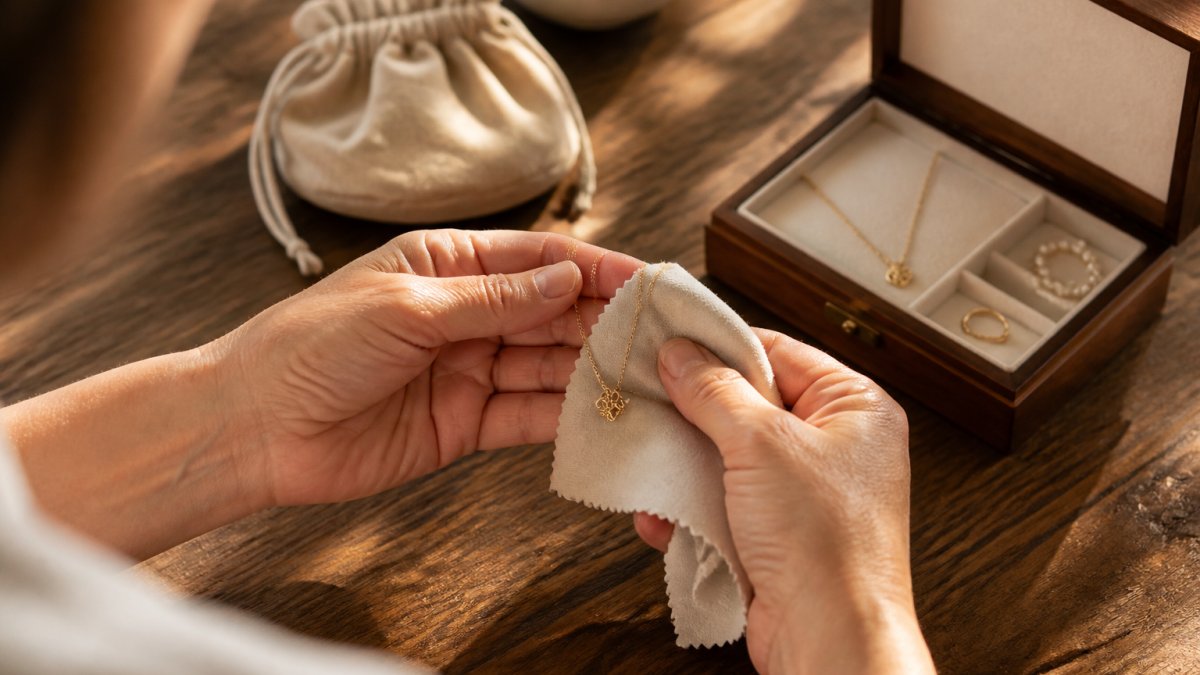
Care is where sustainability becomes tangible. Learn how to clean gold necklaces and other heirloom pieces safely to preserve them for future generations. A responsibly sourced piece that is never cleaned, inspected, or documented will not survive to be an heirloom.
Daily Cleaning and Protective Storage
- Wipe after wear. A soft, lint-free cloth removes skin oils and lotions before they attract dust into prongs and settings.
- Store separately. A lined jewelry box with individual compartments, or a soft pouch per piece, prevents scratches and chain tangles.
- Control humidity. A cool, dry drawer away from direct sun is better than a bathroom shelf; steam and humidity degrade some settings and accelerate tarnish.
Annual Inspection and Repair Planning
Once a year, have the piece inspected by a jeweler. The inspection is usually quick and often free; the point is to catch loose prongs, worn shanks, and tired clasps before a stone is lost.
- Prongs: ask the jeweler to check each prong for thinning and re-tip as needed.
- Shank: check for thinning at the bottom of the band, the most common wear point on rings.
- Clasps and chains: lobster clasps and thin chains wear out; replacing a clasp is inexpensive compared with losing a pendant.
Documentation and Provenance for Future Generations
This is the step most families skip, and it most affects whether the piece is understood, and valued, decades later. Build a single heirloom record, physical and digital, that travels with the piece.
What the record should contain:
- Photographs of the piece from multiple angles, plus close-ups of hallmarks, maker's marks, and any engraving.
- Metal details, purity stamp, weight, and whether the metal is recycled, Fairmined, or vintage.
- Gemstone details, species, carat weight, cut, color, clarity, and whether the stone is lab-grown, natural, or treated. Note any certificates by number.
Store one copy with the piece and one off-site (a scanned PDF in a secure cloud folder or a safe-deposit box). Insurers typically ask for the appraisal and photographs anyway.
Repairability and the Long View
Before passing the piece on, confirm it can still be serviced. A jeweler should tell you whether the setting can be re-tipped, the shank resized, and the stones reset if tastes change. A piece that can be reset stays in the family even when styles shift.
Building Your Heirloom Selection Checklist
Most sustainable-jewelry guides stop at "buy recycled or vintage." That's necessary but not sufficient for a piece you intend to pass down, an heirloom must survive resizing, repair, restyling, and decades of changing tastes. Print this checklist and ask the seller to answer each line in writing.
Construction and Repairability
Repairability is the most underrated heirloom criterion. A piece that cannot be repaired or resized will eventually be retired to a drawer.
- Solid metal, not plated. Look for stamps such as 14K, 18K, 585, 750, 925, or PT950 (Buying Platinum, Gold, and Silver Jewelry). Plated or gold-filled pieces have a finite lifespan because the outer layer wears through and cannot be restored.
- Prongs and settings are serviceable. Ask whether the setting can be re-tipped or re-pronged. A jeweler should be able to replace worn prongs without replacing the entire head.
- Shank is thick enough to resize. A band under roughly 1.5 mm is difficult to resize more than once or twice without thinning. Ask the seller for the shank thickness in millimeters.
Resizing and Generational Adaptability
A ring sized for one finger today may need to fit a different hand in 30 years. Design choices that make resizing easy:
- Plain or lightly detailed shanks resize more cleanly than shanks with full-wrap engraving or channel-set stones.
- Prong-set center stones are easier to re-tip than bezels, though bezels are more secure for daily wear, a genuine trade-off worth discussing with the jeweler.
- Necklaces and bracelets can be lengthened or shortened with a chain extender or a new clasp, which is far cheaper than resizing a ring.
Total Cost of Ownership
Purchase price is only the first number. A realistic long-term view includes:
- Annual inspection and cleaning, many jewelers offer this at no charge; confirm before purchase.
- Prong re-tipping, typically needed every several years on daily-wear rings.
- Resizing, one or more times over a lifetime.
Ask the seller for a written care and service schedule. A piece with a documented service history is easier to insure and easier to hand down.
Documentation and Provenance
- Metal purity and weight are stated on the receipt.
- Gemstone details, species, carat weight, cut, color, clarity, and whether the stone is lab-grown, natural, or treated, are documented.
- Origin claims (recycled, Fairmined, vintage) are backed by a certificate, receipt, or written statement from the seller.
Inclusive Family Preferences
An heirloom only works if someone wants to wear it. Before committing:
- Confirm the recipient's style, metal color, scale, and whether they wear rings, necklaces, or earrings at all.
- Ask about metal allergies, nickel sensitivity is common; 18K yellow gold, platinum, and palladium are safer than white gold alloys that contain nickel.
- Respect cultural and religious significance, some stones and symbols carry meaning that should be discussed, not assumed.
Choosing Your Family's First Heirloom Piece
Start with the recipient.
Consider the occasion and relationship. A gift for your daughter carries different weight than one for your wife or mother.
Research the materials.
Test the piece's practicality. Will the recipient actually wear it?
Plan for documentation. Before finalizing, know how you'll record the piece's story, photos, appraisal, personalization details.
Alternatives to Traditional Heirloom Jewelry(page:3) explores other meaningful gift options if a necklace doesn't fit your specific situation.
Frequently Asked Questions
What is considered heirloom jewelry?
Heirloom jewelry is a piece designed and constructed to last multiple generations, typically made from durable materials like solid precious metals and quality gemstones. What makes jewelry heirloom-quality is its combination of timeless design, solid construction, and emotional significance to your family. Sustainable heirloom jewelry prioritizes responsible sourcing, traceable materials, and durable craftsmanship so the piece can be worn, maintained, and passed down without losing its integrity or meaning.
How do I choose jewelry that will last for generations?
Look for solid metal construction (not plated), ethically sourced or recycled precious metals, and gemstones that resist scratching and fading. Personalized heirloom jewelry with meaningful engravings or custom messaging adds emotional durability alongside physical durability. Check that the piece is repairable and resizable, so it can adapt as it passes to the next generation. Verify the jeweler offers documentation of materials and provenance, which strengthens the piece's story and value for your family.
What materials should I look for in sustainable jewelry?
Prioritize recycled gold, recycled silver, and other recycled precious metals, which reduce environmental impact and support a circular economy. Lab-grown gemstones and ethically sourced diamonds offer low-impact processing compared to mined gemstones. Vintage and pre-loved jewelry are also excellent sustainable choices, as they extend the lifecycle of existing pieces. Always verify transparent supply chains and responsible sourcing practices from the jeweler to ensure fair labor and environmental standards.
Can custom or personalized jewelry become a family heirloom?
Yes. Personalized heirloom jewelry with custom messages, engravings, or meaningful designs often becomes more treasured across generations because it carries your family's unique story. The key is ensuring the piece is constructed from durable, sustainable materials and designed to withstand decades of wear and care. Custom pieces from reputable makers who use solid precious metals and quality gemstones will hold their sentimental and physical value, making them ideal candidates for passing down to daughters, wives, mothers, and grandmothers.
Choosing sustainable jewelry for family heirlooms requires balancing beauty, durability, ethics, and personal meaning. The pieces you select today become the stories your children and grandchildren inherit. Thread & Flame Co helps you create those heirlooms through meaningful necklace gifts paired with custom message cards that capture why each piece matters. Start with our curated collections of sustainable, personalized jewelry designed to celebrate the people you love most.
