

Table of Contents
- Why an Initial Necklace Is a Wardrobe Staple
- How to Layer Initial Necklaces Like a Pro
- Finding the Best Chain Length for Initial Necklaces
- Styling Initial Necklaces with Other Jewelry
- Matching Metals to Skin Tone and Style
- Choosing the Right Neckline for Your Pendant
- Making It a Gift: Personalization and Presentation
- Your Initial Necklace Styling Checklist
- Frequently Asked Questions
Last Updated: September 9, 2026
A personalized initial necklace is more than jewelry; it is a wearable keepsake that carries a name, a memory, or a quiet declaration of self. Whether you are treating yourself or searching for a sentimental gift, the personalized initial necklace styling guide for women we have assembled here will help you wear it with intention.
Length, layering, metal finish, and neckline all change how an initial pendant reads. Below, we show you how to style initial necklaces for every occasion, match them with other jewelry, and ensure the piece you choose actually gets worn.
Why an Initial Necklace Is a Wardrobe Staple
An initial necklace is the rare accessory that works with everything from a white tee to a silk evening gown because it is inherently personal. Unlike trend-driven pieces, a monogram or single letter pendant holds steady meaning.
The versatility comes from the letter itself. A cursive script initial feels romantic and whimsical, block lettering reads modern and bold, and Old English adds a vintage edge.
How to Layer Initial Necklaces Like a Pro
Layering is where initial necklaces move from simple to striking, and the secret is mixing lengths and textures rather than matching them perfectly. Start with a choker or collar length piece at 14 to 16 inches, add a princess length chain at 18 inches, and finish with a longer pendant at 20 to 24 inches for a balanced cascade. The goal is to create depth without tangling.
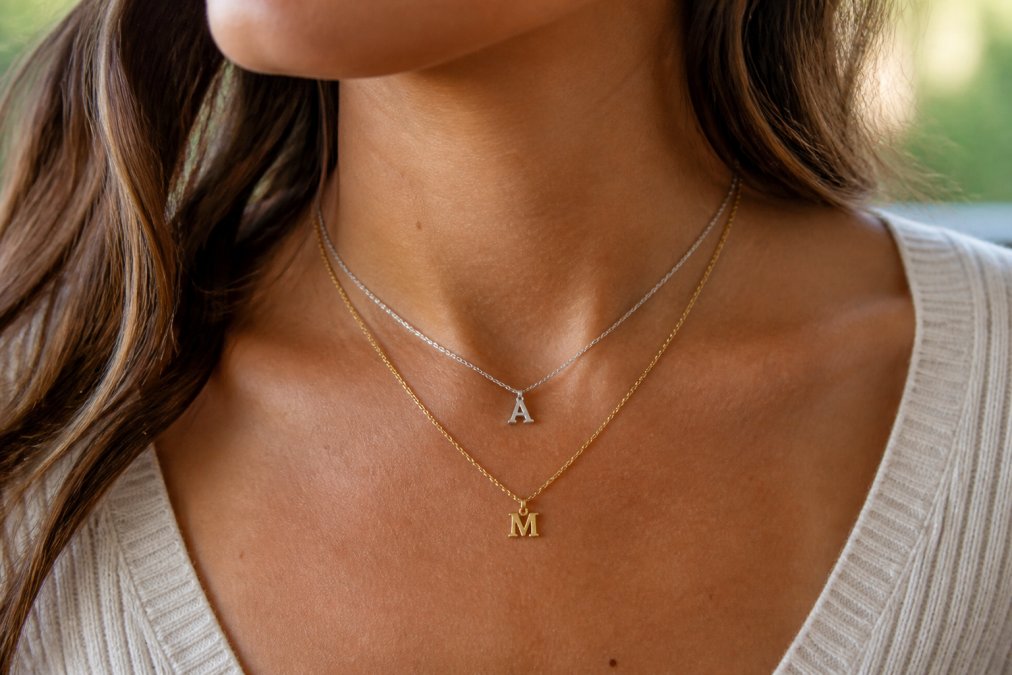
Avoid layering two necklaces of nearly identical length, which causes them to knot. Vary chain styles, pairing a delicate cable chain with a chunkier curb link, and let your initial pendant sit as the focal point. For a curated look, stack two pendants that spell out a child's initials or a shared monogram.
Finding the Best Chain Length for Initial Necklaces
The best chain length depends almost entirely on the neckline you plan to wear. A 16-inch chain rests at the base of the throat and pairs with boat necks and crew cuts, while an 18-inch princess length falls just below the collarbone and suits most tops (thespruce.com). For deep V-necks or wrap dresses, a 20 to 24-inch chain lets the pendant sit in the hollow of the chest.
| Chain Length | Placement | Best Necklines | Vibe |
|---|---|---|---|
| 14-16 in (choker) | Base of throat | Boat neck, off-shoulder, crew | Dainty, modern |
| 18 in (princess) | Below collarbone | Most tops, button-downs | Classic, everyday |
| 20-24 in (matinee) | Chest / décolletage | V-neck, wrap, low-cut | Statement, elongating |
If buying as a gift, an 18-inch chain with an adjustable extender is the safest choice because it adapts to most body types and necklines.
Styling Initial Necklaces with Other Jewelry
Styling initial necklaces with other jewelry is about creating a conversation without letting pieces compete. Keep earrings and bracelets quieter when the initial necklace is the hero, and lean on complementary metals rather than matching exactly.
For a stacked look, mix your initial pendant with a birthstone or delicate bar necklace to tell a fuller story. A whimsical touch, like adding a tiny charm below your initial, gives the stack a personal signature.
Matching Metals to Skin Tone and Style
Matching the metal of your initial necklace to your skin tone is one of the most practical decisions you can make. The vein test is simplest: blue or purple veins point to cool-toned metals like sterling silver and white gold, while green veins point to warm metals like yellow gold and rose gold.
Style should override rules. A woman who loves rose gold should wear it regardless of undertone. The real consideration is durability: a personalized initial necklace is often worn daily, so the metal's ability to withstand sweat, lotion, and friction matters as much as its color.
Here is a practical durability breakdown based on common metal options for initial pendants and chains:
| Metal Type | Tarnish Resistance | Scratch Resistance | Best For | Trade-Offs |
|---|---|---|---|---|
| 14k Solid Gold | High | Moderate | Daily wear, sensitive skin | Higher cost; softer than lower karats but still strong for everyday |
| 14k Gold Fill | High | Moderate | Daily wear on a budget | Gold layer is mechanically bonded; will not flake, but can wear thin over decades |
| 10k Solid Gold | Very High | High | Active lifestyles | Slightly paler yellow due to higher alloy content |
| Sterling Silver (rhodium-plated) | High (with plating) | Low | Occasional wear, cool undertones | Rhodium plating wears off in 6-12 months; needs replating to maintain shine |
| Sterling Silver (unplated) | Low | Low | Tarnish-prone; requires regular polishing | Reacts to sulfur in air and sweat; turns dark without care |
| Gold Vermeil (2.5 microns) | Moderate | Low | Affordable gold look | Thick gold layer over sterling; still requires care to avoid scratching |
| Rose Gold (14k) | High | Moderate | Warm undertones, romantic style | Alloy includes copper; can cause reactions in extremely sensitive skin |
A common pattern is that the chain outlasts the pendant's finish. With a vermeil pendant, expect the gold layer to wear at contact points, the bail and the back against your skin. Remove vermeil pieces before swimming, showering, or heavy exercise.
For sensitive skin, nickel is the primary irritant in jewelry alloys (the American Academy of Dermatology). Look for pieces labeled nickel-free or hypoallergenic; sterling silver contains copper, not nickel, making it safe for most. If layering a gold initial with a silver chain, the harder metal can scratch the softer one, so separate them with a small silicone bead or keep them on different lengths.
Choosing the Right Neckline for Your Pendant
The neckline of your top or dress determines how your initial pendant sits. A crew neck calls for a shorter chain that rests above the fabric, while a collared shirt looks best with the pendant tucked inside or hanging just below the collar points.
Here is the visual cheat sheet most guides skip, a direct pairing of pendant size and chain length to specific necklines so you can stop guessing:
| Neckline | Best Chain Length | Ideal Pendant Size | Styling Rule |
|---|---|---|---|
| Crew Neck / T-shirt | 16-18 in | 10-14 mm | Pendant should rest above the fabric line, not on it; if it touches the collar, go shorter |
| V-Neck (shallow) | 18-20 in | 12-16 mm | Pendant should sit in the V's opening, not above it; a longer chain creates a vertical line |
| V-Neck (deep) | 20-24 in | 14-18 mm | Let the pendant rest at the sternum, not in the cleavage; this elongates the torso |
| Boat Neck / Off-Shoulder | 14-16 in | 8-12 mm | A choker or collar length highlights the collarbone; keep pendant dainty to avoid competing with the wide neckline |
| Turtleneck / Mock Neck | 18-24 in | 12-18 mm | Pendant must hang below the turtleneck's hem; longer chains create a slimming vertical line |
| Collared Shirt | 16-18 in | 10-14 mm | Wear pendant inside the collar for a preppy look, or outside for a relaxed vibe; ensure it clears the top button |
| Sweetheart / Strapless | 16-18 in | 10-14 mm | Pendant should rest just above the bust line, drawing the eye up toward the face |
| Halter | 16-18 in | 8-12 mm | Skip the necklace or use a very short chain; halter necklines already frame the shoulders, and a pendant can tangle with the tie |
| Scoop Neck | 18-20 in | 12-16 mm | Pendant should sit in the scoop's curve; a longer chain looks disconnected, so measure against the actual scoop depth |
| High Neck / Jewel | 20-24 in | 14-18 mm | A longer chain worn over the high neck creates contrast; avoid short chains that disappear into the fabric |
Build your outfit around the necklace rather than the other way around. If you want to wear your grandmother's initial pendant to dinner, choose a neckline that frames it, like a scoop neck or camisole, rather than a high neck that hides it.
Pendant weight relative to neckline is often overlooked. A heavy 18mm statement pendant on a delicate 1mm cable chain will pull forward and flip on a scoop neck. Match pendant weight to chain gauge: under 3 grams works with 1mm chains, 3-6 grams needs a 1.5mm chain, and over 6 grams requires a 2mm curb or box chain.
Making It a Gift: Personalization and Presentation
When an initial necklace is a gift, the presentation matters as much as the piece itself, because the ritual of unwrapping is part of the emotional experience. A custom message card adds meaning that a plain jewelry box cannot match.
The most memorable gifts connect the initial to a specific memory or sentiment. Instead of simply giving a "J" pendant to your daughter, pair it with a note that says, "J for the joy you brought into our lives." When the necklace arrives with a personal story attached, it becomes a keepsake rather than just another accessory.
Your Initial Necklace Styling Checklist
Use this checklist whenever you are styling an initial necklace or shopping for one as a gift. It condenses the guidance above into a quick reference you can consult before you commit to a look.
- Choose a letter style that matches your personality: cursive for romance, block for modern, Old English for vintage
- Pick a chain length based on your most common neckline, with 18 inches as the safe default
- Select a metal finish that flatters your skin tone, or choose your favorite and commit to it
- Layer with chains of different lengths, not identical ones, to avoid tangling
- Keep other jewelry minimal when the initial pendant is the focal point
- Match the necklace to your neckline so the pendant sits visibly, not hidden
- For gifts, pair the pendant with a personalized message that explains its meaning
The difference between an initial necklace that sits in a drawer and one that becomes a daily staple comes down to fit, finish, and feeling. When the length suits your wardrobe, the metal suits your skin, and the meaning suits your heart, you will reach for it every day.
Frequently Asked Questions
How do you layer an initial necklace with other chains?
Start with a choker-length chain, add your initial necklace at princess length, and finish with a longer pendant at matinee length. Vary the metal finishes or keep them uniform for a polished look. Mixing textures, like a rope chain with a cable chain, adds depth without looking cluttered. The goal is to create a balanced V-shape that complements your neckline.
What is the best chain length for a personalized initial necklace?
The best chain length depends on your neckline and desired effect. A 16-inch chain sits at the collarbone and works beautifully with crew necks and off-the-shoulder tops. An 18-inch chain is the most versatile, resting just below the collarbone and pairing well with most outfits. For deeper necklines, a 20-inch chain adds an elegant, elongated line.
Are initial necklaces still in style in 2026?
Yes, initial necklaces remain a timeless jewelry staple. Current trends favor dainty, personalized pieces that can be layered or worn alone. The shift is toward meaningful styling: mixing metals, combining your initial with a birthstone pendant, or stacking it with other sentimental charms. The key is choosing quality materials like 14k gold or sterling silver so the piece lasts.
How do you choose the right metal for your skin tone?
A quick test: check the veins on your wrist. Blue or purple veins often pair well with silver and white gold, while green veins suit yellow gold and rose gold. If you see a mix, you can wear both. More important than rules is how the metal makes you feel. If you wear mostly gold accessories, a gold initial necklace will blend seamlessly with your jewelry wardrobe.