

Table of Contents
- What Is a Message Card Necklace?
- What to Write in a Necklace Gift Card
- Necklace Message Card Ideas by Occasion
- Personalized Message Necklace: Design and Materials
- Message Necklace for Daughter: Choosing the Right Gift
- Chain Length, Pendant Size, and Fit
- Gift Presentation and Delivery Checklist
- Frequently Asked Questions
Last Updated: October 8, 2026
What Is a Message Card Necklace?
A message card necklace pairs a pendant with a personalized message card explaining the gift's significance.
The pendant might be a heart, infinity knot, key, butterfly, or anchor, each with its own meaning.
It becomes a conversation starter and daily reminder: when someone asks about the pendant, the wearer shares the symbol and the story.
What to Write in a Necklace Gift Card
The message card is where your gift becomes unforgettable. A generic "Happy Birthday" misses the point.
Strong message card text is specific, brief, and honest. Avoid clichés: instead of "You're amazing," try "The way you handled that situation showed me your real strength."
The best messages fit on a standard card, roughly 50-100 words. Read your draft aloud; if it feels stiff or generic, rewrite it.
Messages for Daughters
A message for your daughter should acknowledge her growth and your pride in who she's becoming.
Strong examples balance warmth with specificity:
- "You've always had the courage to be yourself, even when it was harder. That's the strength I see in you every day."
- "Watching you navigate this year taught me something about resilience I needed to learn. Thank you for showing me how it's done."
- "You make me proud not because of what you achieve, but because of who you are becoming."
Avoid messages about appearance, achievement, or comparison. The most meaningful ones acknowledge her character, choices, or impact on others.
Messages for Wives
A message for your wife should feel like a continuation of a long conversation, not a formal announcement. Remind her why you chose her and why you'd choose her again.
Effective messages often reference a specific moment, inside joke, or quality you fell in love with:
- "Every day with you is easier because you make everything better. Thank you for choosing us."
- "You are my favorite person to do nothing with and my greatest partner in everything that matters."
- "The strongest thing about us isn't what we've survived. It's that we chose each other through it all."
Match the tone to your relationship: playful if you're playful, plain sincerity if you're reserved.
Necklace Message Card Ideas by Occasion
Different occasions call for different messages, because context shapes what you're really trying to say.
Birthdays and Milestones
Birthday messages should acknowledge the milestone while pointing toward the future. A 21st differs from a 50th, but both can honor growth.
Consider these approaches:
- Reference a specific memory from the past year that shows growth or change
- Name a quality that's become more visible or important
- Express hope or anticipation for what comes next
Example: "This year you learned what you're capable of. Next year, I hope you discover what you actually want. Happy birthday."
For milestone birthdays (graduations, anniversaries, major transitions), validate the significance: it's not just another year, it's a turning point.
Holidays and Thank You Gifts
Holiday gifts acknowledge the season and your relationship; thank you gifts recognize something specific someone did.
For holidays, messages can be warmer and more reflective:
- "This year I'm grateful for you in ways I didn't expect."
- "You make the holidays feel like home."
For thank you gifts, be specific about what you're grateful for:
- "Thank you for showing up when I needed it most."
- "Your kindness changed how I see myself. I wanted you to know that."
Specificity turns a generic thank you into evidence you were paying attention.
Personalized Message Necklace: Design and Materials
The physical quality of a message card necklace matters as much as the words. A cheap pendant wastes a profound message; a stunning pendant with no context is just another necklace. This section covers how finishes behave, what "hypoallergenic" really means, and how to match a metal to the recipient's habits.
Pendant Styles and Symbols
Different pendant designs carry different symbolic weight, so choose one that matches your message.
Heart pendants represent love and emotional connection, romantic gifts, mother-child relationships, close friendships. An infinity knot symbolizes an unbreakable bond, often chosen for relationships meant to last.
The symbol should reinforce your message: an anchor or key for strength and resilience, a butterfly for transformation, an infinity knot or heart for enduring love.
Metal Finishes, Plating, and What Actually Lasts
"Gold plated" and "gold filled" are not the same product, and the difference determines whether the finish survives a year of wear. Here is how the common options compare:
| Material | What it is | Tarnish and wear behavior | Best for |
|---|---|---|---|
| Sterling silver (925) | 92.5% silver alloyed with copper | Tarnishes over time; darkens with sulfur and humidity; polishes back to bright | Daily wear with occasional polishing |
| Gold plated | A thin gold layer over brass or steel | Wear-through at high-contact points (clasp, pendant edge) with constant friction | Occasional or special-occasion wear |
| Gold filled | A thicker bonded gold layer (typically a meaningful fraction of the total weight) | Far more wear-resistant than plating; keeps color through years of normal use | Daily wear when gold tone is required |
| Rose gold plated | Copper-rich gold layer over base metal | Warm tone; can shift color as the copper oxidizes | Fashion-forward, lower-wear pieces |
| Stainless steel | Solid alloy, often 316L | Highly tarnish-resistant; minimal maintenance | Showers, workouts, hands-on work |
| Titanium | Solid, lightweight metal | Essentially non-tarnishing; very low reactivity | Sensitive skin, lightweight preference |
Plating thickness is the number most listings hide. A thicker layer lasts longer than a thin flash coating, but even good plating eventually wears at the clasp and pendant edge. Gold filled costs more but outlasts plating by a wide margin under daily wear.
Skin Sensitivity: What "Hypoallergenic" Actually Means
The most common cause of jewelry irritation is nickel, used in many base alloys and plating layers. If the recipient has reacted to earrings or watch backs before, screen for nickel first.
Look for these labels and what they mean:
- Nickel-free, the finished piece is made without nickel in the alloy or plating.
- Lead-free and cadmium-free, both are restricted in jewelry under U.S. consumer product rules, so a reputable seller should confirm compliance.
- Hypoallergenic, a marketing term, not a regulated standard. It signals low reactivity but does not guarantee it. Nickel-free is the more useful, verifiable claim.
Matching the Metal to the Recipient's Lifestyle
Consider how the necklace will actually be worn:
- Swims, showers, or works out in jewelry, stainless steel or titanium. Chlorine and sweat accelerate tarnish and plating wear on silver and plated pieces.
- Wears jewelry daily but removes it for water, sterling silver or gold filled. Both hold up for years with basic care.
- Wears it a few times a month, gold plated or rose gold plated is a reasonable, lower-cost choice.
Care That Keeps the Finish Intact
A few habits extend its life:
- Store it in a dry pouch or box, not loose in a drawer where it rubs against other pieces.
- Wipe sterling silver with a soft polishing cloth; use a silver polishing cloth for heavier tarnish.
- Keep plated pieces away from water, sweat, and abrasive cleaners.
A message card necklace is meant to be worn, so match the metal to the recipient's real routine and it will stay looking like the gift you intended.
Message Necklace for Daughter: Choosing the Right Gift
A message necklace for your daughter works at nearly any age, but the approach shifts with where she is in life.
For younger daughters (pre-teen to teen), validate her emerging identity and reassure her that you see her becoming herself.
For adult daughters, shift to peer-to-peer respect. Acknowledge what she's built, what she's overcome, or the person she's chosen to be.
Chain Length, Pendant Size, and Fit
The technical details determine whether the gift gets worn or stored in a drawer. A necklace that doesn't fit becomes unwearable, no matter how meaningful the message. This section translates chain lengths into where the necklace actually sits.
Where Each Chain Length Falls
Chain length is measured in inches around the neck, clasp to clasp. Here is where each common length lands on an average adult frame:
| Length | Where it sits | Typical use |
|---|---|---|
| 14 in | Base of the neck, above the collarbone | Choker; youth and petite frames |
| 16 in | At or just below the collarbone | Classic everyday length; most common for pendants |
| 18 in | Just below the collarbone | The most popular adult length; works with most necklines |
| 20 in | Between collarbone and sternum | Slightly lower; good for larger pendants |
| 22 in | At or near the top of the sternum | Casual, layered looks |
| 24 in | At the sternum | Statement or long pendant looks |
| 30 in and up | Below the sternum | Opera or lariat styles; layering base |
Two people can wear the same 18-inch chain at different heights: neck circumference, shoulder width, and torso length all shift the drop. A 16-inch chain on a petite frame can sit where an 18-inch sits on a taller frame.
Matching Pendant Size to Chain Length
The pendant and chain should be in proportion. A useful rule:
- Small pendants (under about 0.5 in), pair with 16-18 in chains. On a long chain, a small pendant can look lost.
- Medium pendants (about 0.5-1 in), pair with 18-20 in chains. This is the most versatile combination.
- Large pendants (over about 1 in), pair with 20-24 in chains. A short chain with a large pendant can crowd the collarbone and feel heavy.
For layering, the shortest chain should hold the smallest pendant so pieces don't overlap and tangle.
Layering Math
A common layering pattern uses a 2-inch gap so each pendant sits in its own space:
- Base layer: 16 in
- Middle layer: 18 in
- Top layer: 20 in
If the recipient already wears a favorite chain, measure it and choose a message card necklace that sits 2 inches above or below, so the new piece doesn't compete with what they love.
Sizing by Recipient and Frame
- Petite or narrow-shouldered frames, 16-18 in usually sits at the collarbone; a 14-16 in choker works if they like shorter pieces.
- Average adult frames, 18 in is the safe default; 16 in for a higher, more delicate look.
- Taller frames or broader shoulders, 20-22 in often sits where 18 in sits on an average frame.
How to Measure Without Guessing
If you can measure a necklace the recipient already wears, lay it flat and measure clasp to clasp; that number is the length to match or adjust from.
If you cannot measure, use these fallbacks:
- A standard women's crew-neck T-shirt neckline sits near where an 18-inch chain falls.
- A button-down shirt's second button is roughly at the 20-inch mark on an average frame.
- When in doubt between two lengths, choose the longer one for an adult and the shorter one for a teen or petite recipient.
Adjustability and Clasps
An extender chain adds 2-3 inches of adjustability, solving most sizing uncertainty. A lobster clasp is most secure and easiest one-handed; a spring-ring is lighter but harder to work.
Fit is the difference between a necklace worn weekly and one that stays in the box. Get length and pendant proportion right, and the message card gets read every time it goes on.
Gift Presentation and Delivery Checklist
The unboxing experience matters. A message card necklace deserves presentation matching its emotional weight: packaging that protects the necklace while creating a moment of discovery.
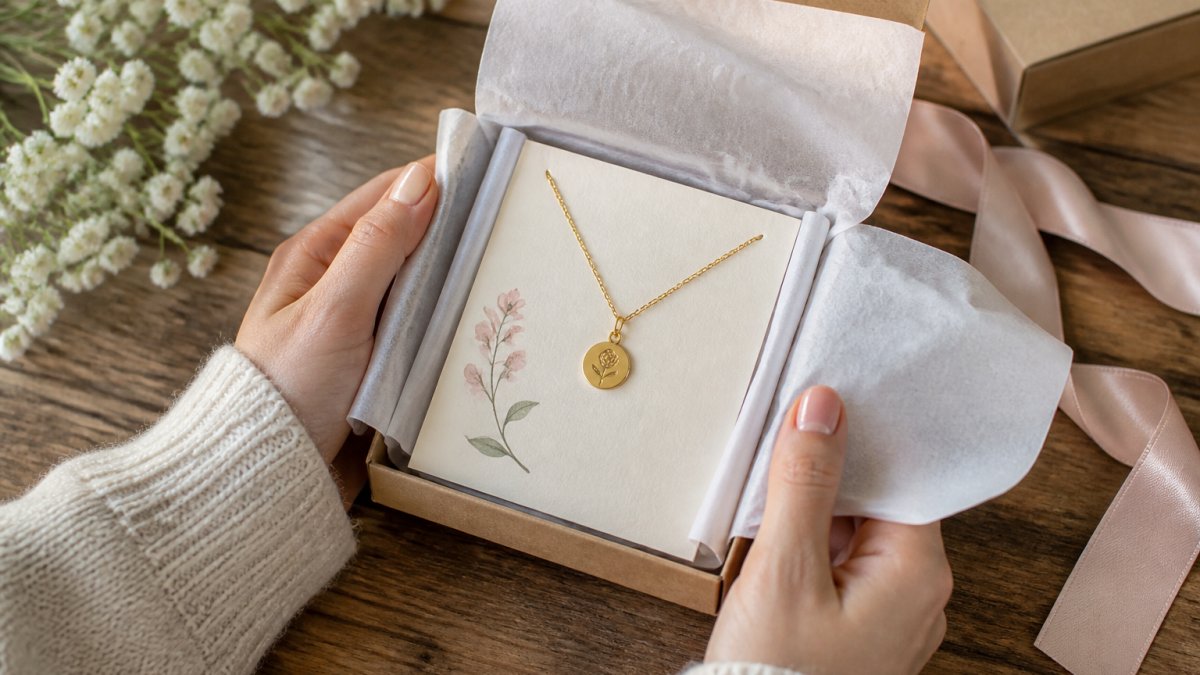
Before sending or gifting your message card necklace, confirm these details:
| Element | What to Check | Why It Matters |
|---|---|---|
| Chain length | Matches recipient's typical necklace size | Ensures the gift will actually be worn |
| Pendant condition | No damage, scratches, or defects | First impression affects how the gift feels |
| Message card | Proofread for spelling and tone | Errors undermine the emotional impact |
| Packaging | Protective but attractive | Sets the tone for the unboxing experience |
| Delivery timing | Arrives when promised | Reliability builds trust in the gift |
| Message card placement | Visible but protected | Recipient sees it immediately |
If shipping, use tracking and consider insurance for higher-value pieces.
A message card necklace works because it combines visual symbolism and written words to express what's hard to say out loud.
Frequently Asked Questions
What should you write on a necklace message card?
Your message should reflect your relationship and the occasion. For daughters, write about pride and love; for wives, express devotion and partnership; for mothers and grandmothers, acknowledge their influence and gratitude. Keep messages heartfelt but concise, three to five sentences work best. Include the reason you chose this specific necklace, reference a shared memory, or express what the recipient means to you. Personalization makes the gift memorable.
How do you choose a message card necklace for someone you love?
Start by considering the recipient's style, lifestyle, and the occasion. Think about pendant designs that hold meaning, hearts for love, infinity knots for unbreakable bonds, keys for new chapters. Choose metals that match their existing jewelry (silver-toned, gold-plated, or rose gold-plated finishes). Consider chain length based on how they typically wear necklaces. Finally, match the message card content to the recipient's personality and your relationship. Quality materials and thoughtful presentation ensure the gift feels special.
What are popular pendant styles for message card necklaces?
Common pendant designs include heart pendants for romantic or familial love, infinity knots symbolizing eternal bonds, anchor pendants representing stability, butterfly pendants for transformation, and key pendants for new beginnings. Each design carries symbolic meaning that complements your written message. Some necklaces feature cubic zirconia or crystal accents for added elegance. Thread & Flame Co offers curated collections with designs specifically chosen to celebrate daughters, wives, mothers, and grandmothers.