

Table of Contents
- Step 1: How to Find Coordinates for Jewelry That Mark a Meaningful Location
- Step 2: Choose the Best Metals for Custom Necklaces
- Step 3: Pick a Coordinates Necklace Design and Engraving Style
- Coordinates Necklace Engraving Ideas for Couples
- Step 4: Add a Custom Message Card and Presentation Details
- Step 5: Confirm Sizing, Shipping, and Care Before You Order
- Common Mistakes to Avoid When Ordering a Coordinates Necklace
- Conclusion
- Frequently Asked Questions
Last Updated: September 13, 2026
Step 1: How to Find Coordinates for Jewelry That Mark a Meaningful Location
A coordinates necklace is personalized jewelry engraved with the latitude and longitude of a meaningful place. This guide walks through the full ordering process, from pulling accurate coordinates to confirming sizing and care. The hardest part isn't the jewelry, it's getting the numbers right, because a single wrong digit points to the wrong spot.
Most couples pick a location first, then look up the numbers, backwards, and where errors creep in. Start with the exact spot, then convert it.
Here's the reliable sequence:
- Open a mapping app and drop a pin on the exact location, not the city center
- Long-press or right-click the pin to reveal the coordinate pair
- Copy both numbers in full, including the decimal points
- Double-check by pasting the pair back into the search bar
- Save the pair in a note before you start shopping
That last step matters: coordinates get retyped at checkout, and retyping is where digits get dropped.
Decimal Degrees vs. Degrees, Minutes, Seconds
Coordinate pairs come in two common formats, and knowing which one your jeweler wants prevents a costly mistake. Decimal degrees look like 40.7128, -74.0060; degrees, minutes, seconds look like 40°42'46"N, 74°00'22"W. Both describe the same spot but read very differently once engraved.
Decimal degrees are shorter, which suits a minimalist bar necklace. Degrees, minutes, seconds carry more visual texture and fill a disc charm nicely. Ask which format the design accommodates before you finalize. A National Geospatial Program coordinate guide explains the conversion if you need to switch between the two.
Step 2: Choose the Best Metals for Custom Necklaces
The best metals for custom necklaces balance wearability, skin sensitivity, and how the piece ages. Sterling silver, gold vermeil, and solid gold are the three you'll see most often, and each behaves differently over years of wear.
Sterling silver is the most affordable and classic, hypoallergenic for most wearers, though it tarnishes and needs occasional polishing. Gold vermeil layers a thick gold coating over sterling silver for the warmth of gold at a lower cost, but the coating can wear thin at friction points. Solid gold costs the most and holds up best, which is why it's the common choice for an anniversary gift meant to last decades.
Durability and Wear: How Each Metal Holds Up
Engraving style changes how a metal ages. For daily wear, ask for deeper engraving and a tarnish-resistant finish.
Step 3: Pick a Coordinates Necklace Design and Engraving Style
Design comes down to three shapes, a font choice, and, for couples, a layout logic most guides skip. The shape you pick should mirror the relationship, not just fit the numbers.
Shape Psychology for Couples
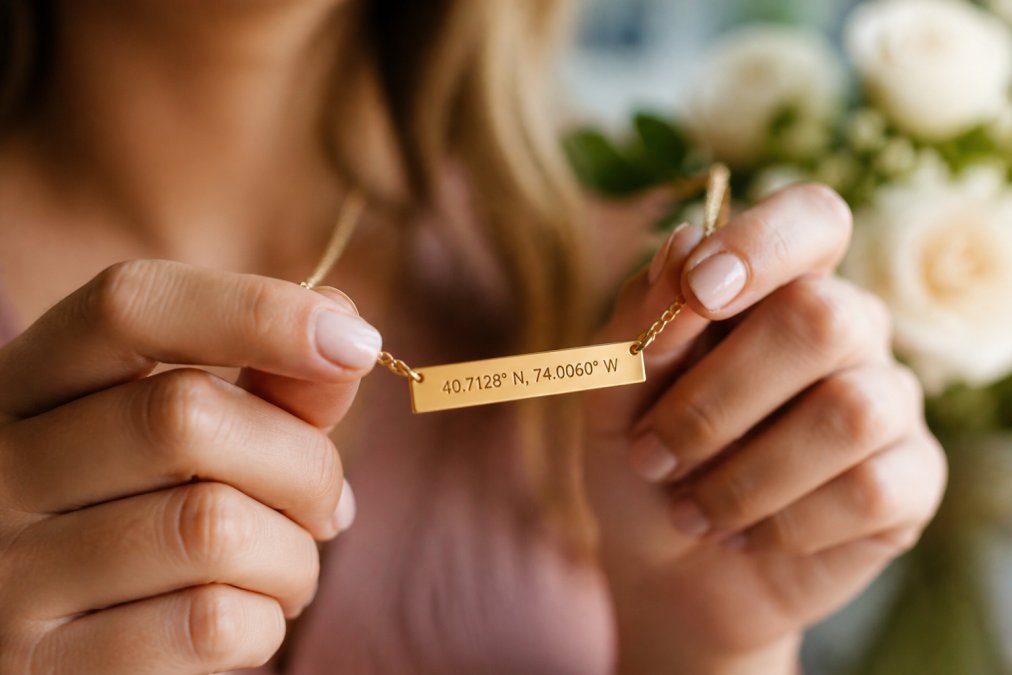
Bar necklaces give a long, horizontal line for a full coordinate pair; the straight edge reads as steady and grounded, which is why couples often choose a bar for a first home or a long marriage. Disc charms offer a compact circle that suits shorter decimal-degree formats, and the lack of a start or end carries a subtle "no beginning, no end" reading that pairs well with an anniversary or vow renewal. Compass pendants add a directional motif, and the needle implies "you are my direction."
For two people, the strongest layouts are the ones that physically connect:
- Interlocking circles (two rings, one link). Two separate discs joined by a single jump ring. The overlap is the relationship; the two centers are the two people. This is the most literal couples design and the one buyers most often regret not choosing.
- Split bar (one bar, two halves). A single bar engraved with two coordinate pairs, one on each end, meeting in the middle. Works when both partners wear a half, or when one person wears both places.
- Nested discs. A smaller disc layered over a larger one, each holding one coordinate. Reads as two lives overlapping rather than running parallel.
- Single disc, two lines. The most compact option: one coordinate pair on line one, the second on line two, separated by a small heart or dot. Best for buyers who want one piece instead of a set.
Couples who pick a single shared bar often later wish they had chosen a two-part design, because the piece only tells one side of the story. If the necklace represents two people, the design should have two visual anchors.
Font and Legibility Trade-offs
Font selection carries more weight than most buyers realize and interacts directly with the shape you chose. A serif font reads traditional and elegant; a clean sans-serif reads modern and minimal; script looks romantic but can blur at small sizes, so it works best on larger discs.
Legibility is a function of three things at once: font weight, engraving depth, and surface area. A thin script on a 12 mm disc will lose its hairlines; a bold sans-serif on the same disc stays crisp. If your coordinate pair includes a minus sign, check that the font renders it as a clear horizontal stroke, not a dash that could be mistaken for a hyphen.
Request an engraving preview before committing, and check that every digit is distinct, a 3 mistaken for an 8 cannot be fixed after the fact. Read the proof at the actual size it will be engraved; zooming in hides the legibility problems that show up on a finished pendant.
Chain Length and Clasp
Chain length and clasp type round out the design. A 16 to 18 inch chain sits near the collarbone and suits most necklines; a 20 inch chain hangs lower and works better with layered looks (jewelers.org). For a couples set worn daily, a 20 inch chain on one and an 18 inch on the other keeps the two from tangling.
A lobster clasp is the most secure for daily wear; a spring-ring clasp is lighter and easier to fasten one-handed but can work loose over years of use. If the recipient takes the necklace on and off daily, lobster is the safer choice.
Layout Mistakes That Ruin a Couples Design
- Two coordinate pairs on one small disc. The numbers crowd and the two locations blur into one another. Split them across two surfaces instead.
- Centering the text instead of the numbers. The coordinate pair is the focal point; a date or phrase should sit beneath it, not compete with it.
- Mixing formats across a set. If one half uses decimal degrees and the other uses degrees, minutes, seconds, the pair looks mismatched. Pick one format for both.
- Ignoring the back of the pendant. A disc or bar has two faces. The back is free real estate for a date, an initial, or a short phrase, and it costs nothing extra on most orders.
Coordinates Necklace Engraving Ideas for Couples
Engraving ideas for couples usually pair the coordinate pair with a short line of text. The numbers mark the place; the words explain why it matters.
Consider these pairings:
- The coordinates of where you met, with the date beneath
- The coordinates of your first home, with "home is wherever you are"
- The coordinates of a wedding venue, with your anniversary date
- Two coordinate pairs, one on each side, for two meaningful places
- The coordinates of a proposal spot, with a single initial
Keep the text short. Engraved space is limited, and a crowded design loses the clean look that makes minimalist jewelry work, a common mistake is fitting a full sentence onto a bar that only comfortably holds a date.
Step 4: Add a Custom Message Card and Presentation Details
A custom message card turns the necklace into a complete gift rather than just a piece of jewelry. The card carries the sentiment the engraving can't fit, and it's often the part recipients remember. Thread & Flame Co pairs its necklaces with message card jewelry designed to celebrate the people you love most, so presentation is built into the purchase.
When writing your message, be specific, a line naming a shared memory lands harder than a general sentiment. Write it in your own voice, read it aloud once, and rewrite anything that sounds like a greeting card.
Step 5: Confirm Sizing, Shipping, and Care Before You Order
Confirm three things before you pay: chain length, delivery timeline, and care instructions. These cause the most post-purchase frustration and are all easy to verify upfront.
Sizing: Measure, Don't Guess
On sizing, measure a necklace the recipient already wears and loves: lay it flat, measure end to end, and match that number. Guessing leads to exchanges, and personalized jewelry usually cannot be returned once engraved.
Use these benchmarks as a starting point:
- 14 inches, choker, sits at the base of the throat. Rare for daily wear.
- 16 inches, the most common women's length. Sits just below the collarbone.
- 18 inches, sits at or just below the collarbone on most wearers. The safest default for a gift.
- 20 inches, rests on the upper chest. Good for layering or for someone who wears higher necklines.
- 22 inches and up, falls toward the bust. Less common for a single pendant.
Height and build shift these numbers: a 16 inch chain on a petite wearer can sit where an 18 inch chain sits on a taller one. If you cannot measure an existing necklace, ask someone who has seen her wear jewelry rather than guessing from a photo.
For a couples set, measure both wearers separately. Do not assume the same length works for both.
Shipping: Why Personalized Orders Take Longer
The mechanism is simple: engraving happens after you order, not before. A stock necklace can ship the same day, but a personalized one enters a production queue, proof approval, engraving, quality check, packing, before it reaches a carrier. That queue is the single biggest source of missed-occasion frustration.
Plan backward from the date you need it in hand:
- Pick the date you need the gift delivered.
- Subtract the production window the jeweler quotes (ask for it in writing).
- Subtract the shipping transit time for the method you choose.
- Subtract two to three days as a buffer for proof approval and any back-and-forth.
- That final date is your order-by deadline.
A USPS holiday shipping deadlines page is a useful reference for planning around peak seasons, when both production queues and carrier networks slow down. If your deadline falls near a major gift holiday, add extra buffer on top of the standard estimate.
Care: Metal-Specific, Not One-Size-Fits-All
Care is straightforward, but the right routine depends on the metal you chose.
Sterling silver. Tarnishes over time as it reacts with sulfur compounds in the air and on skin. Keep it away from perfume, lotion, and chlorine; store it in a dry pouch rather than a humid bathroom; wipe it with a soft cloth after wearing. A silver polishing cloth restores shine, but avoid abrasive dips on engraved pieces because they dull the recessed lettering.
Gold vermeil. The gold layer sits over sterling silver and wears thin first at friction points, the clasp, the chain where it rubs the pendant, and the back of the pendant against the chest. Keep it away from perfume, lotion, and chlorine, put jewelry on last after lotions and sprays have dried, and store it separately. Once the gold layer wears through, the piece cannot be re-plated at home.
Solid gold. The most forgiving of the three: it does not tarnish and holds engraving depth well, and the main risks are scratches and physical deformation, not chemical wear. A soft cloth and separate storage are usually enough, and it can be professionally polished and re-engraved if needed.
Across all three metals, the habits that matter most are the same: put the necklace on last and take it off first, keep it dry, and store it flat or hanging rather than in a tangled pile.
Common Mistakes to Avoid When Ordering a Coordinates Necklace
The most common mistakes are small and avoidable, but each one turns a meaningful gift into a return:
- Using city-center coordinates instead of the exact spot. The pin should mark the place, not the town.
- Dropping the negative sign. A missing minus sign moves the location to an entirely different part of the world.
- Choosing a metal before checking skin sensitivity. Sterling silver and gold vermeil suit most wearers, but confirm before you commit.
- Guessing the chain length. Measure an existing necklace instead.
- Ordering too late. Engraving adds lead time, so order well before the occasion.
- Skipping the engraving preview. Always review the proof before production begins.
Conclusion
Getting every detail right, from the coordinate format to the chain length, is what separates a keepsake from a return. Thread & Flame Co makes that process simpler with meaningful necklace gifts and custom message card jewelry designed to celebrate the people you love most, so the location and the sentiment arrive together. Choose your coordinates, pick a metal and design, write a message that sounds like you, and confirm sizing and timing before you order. Get started with Thread & Flame Co and turn a meaningful location into a gift.
Frequently Asked Questions
Can I get custom jewelry with coordinates?
Yes. Custom coordinates necklace orders are one of the most popular personalized jewelry requests. You provide the latitude and longitude of a meaningful location, and the jeweler engraves or hand-stamps those numbers onto a pendant, bar, or disc. Thread & Flame Co lets you pair the coordinates with a custom message card for a complete keepsake.
How do I find the exact coordinates for a special location?
Open Google Maps, drop a pin on the spot, then long-press to see the latitude and longitude. You can also right-click on desktop and select the coordinates to copy them. For a coordinates necklace, decimal degrees (for example, 40.7128, -74.0060) work best because they fit neatly on small pendants.
What are the best materials for a custom coordinates necklace?
Sterling silver and gold vermeil are the most common choices. Sterling silver is hypoallergenic, tarnish-resistant with proper care, and affordable. Gold vermeil offers a warmer tone and thicker gold layer than standard plating. Both hold engraving well. If the wearer has sensitive skin, sterling silver or 14k gold is usually the safest bet.
How long does it take to receive a custom engraved necklace?
Turnaround depends on the design, engraving method, and current order volume. Most custom coordinates necklace orders ship within one to three weeks, but peak seasons like holidays can add time. If you need it for a specific date, order early and check the estimated delivery window on Thread & Flame Co's website before checking out.