

Table of Contents
- Why Personalized Gifts Create Stronger Emotional Connections
- The Psychology of Gift-Giving: What Happens in the Brain
- How to Choose a Personalized Gift That Feels Genuinely Thoughtful
- Personalized Necklace Gift for Wife: A Keepsake She'll Wear Daily
- Custom Message Card Jewelry: When Words and Metal Meet
- Budget-Friendly Personalization: Meaningful Gifts Without Overspending
- The Gift-Giver's Paradox: When Personalization Backfires
- Conclusion: Giving a Gift That Carries Your Voice
- Frequently Asked Questions
Last Updated: September 19, 2026
Why Personalized Gifts Create Stronger Emotional Connections
Personalized gifts work because they prove you were paying attention. A necklace engraved with a birthdate or a card bearing a handwritten message tells the recipient they were seen as an individual, not a category. That distinction is the entire point of the benefits of giving personalized gifts: the gift stops being an object and becomes evidence of a relationship.
A generic candle says "I needed a gift." A custom message card jewelry piece says "I know you." The difference sounds small until you watch someone open both.
The emotional connection comes from specificity. When a gift reflects a real detail, the recipient's brain registers it as a meaningful gesture rather than an obligation fulfilled. Many people find that the gifts they remember years later are the ones that referenced something only the giver would know.
At Thread & Flame Co, we build our collections around this idea. Every meaningful necklace gift and message card is designed to carry a specific relationship, not a general sentiment. That focus on one person at a time is what separates a keepsake from a purchase.
The Psychology of Gift-Giving: What Happens in the Brain
Gift-giving is not a social nicety layered on top of biology. It is biology. Researchers who study prosocial behavior have repeatedly found that the act of giving activates reward circuitry in the brain, the same dopamine-linked pathways that light up for food, money, and other primary rewards. That is why a gift that lands well produces a physical lift, not just a polite smile.
The most useful concept here is the warm-glow effect, a term economists and behavioral scientists use to describe the private satisfaction a person gets from giving. The key finding, replicated across decades of research on charitable and interpersonal giving: the giver's reward does not depend on the size of the gift. It depends on whether the giver believes the gift is genuinely helpful or meaningful to the recipient. A $30 gift chosen with real knowledge of the person can produce a stronger warm glow than a $300 gift chosen at random.
That finding is the scientific backbone of personalization. When you engrave a date, a name, or an inside reference, you are not decorating an object, you are signaling to your own brain and to the recipient's that the gift was targeted. Targeted gifts register as helpful. Generic gifts register as transactions.
On the receiving side, the mechanism is different but complementary. Psychologists distinguish between hedonic purchases (things that feel good in the moment) and eudaimonic ones (things tied to meaning, identity, and relationships). Personalized gifts skew eudaimonic. They are not consumed and forgotten; they are kept, displayed, and re-encountered. Every time the recipient sees the object, the original social bond is reactivated. That repeated reactivation is what makes a keepsake feel different from a purchase.
There is also a memory effect at work. Personal relevance is one of the strongest known drivers of encoding and recall. A gift that references a specific shared event gets stored alongside the memory of that event, which is why people can describe a meaningful gift from twenty years ago in detail while struggling to remember what they received last December.
What most guides miss is that the effect runs in both directions. The giver experiences a measurable mood and self-esteem boost when a gift lands well, and personalized gifts land better because they remove the guesswork the recipient would otherwise have to do. The giver is not just buying an object; they are buying a successful social exchange, and the brain rewards that success.
This is why the psychology of gift-giving keeps pointing back to the same conclusion: thoughtfulness beats price. A modest gift that shows real attention outperforms an expensive one that shows none, and the research on the warm-glow effect explains why that is not just a nice sentiment but a predictable pattern.
How to Choose a Personalized Gift That Feels Genuinely Thoughtful
Choosing a personalized gift starts with one question: what does this person actually care about? Answer that honestly and the rest of the decision gets easier. Personalization fails when it is decorative rather than specific.
A practical approach:
- Start with a real detail. A nickname, a date, a shared place, or an inside reference. Anything only the two of you would recognize.
- Match the format to the person. Someone who wears jewelry daily will use a necklace. Someone who does not may prefer a card, a framed message, or an experience.
- Keep the message in your own words. Pre-written options are convenient, but a message you wrote yourself carries more weight.
- Check the practical details. Sizing, metal color, and turnaround time matter more than people expect.
- Set a budget before you browse. Personalized gifts range widely, and knowing your ceiling prevents overspending on the wrong thing.
The thoughtfulness is not in the price tag. It is in the specificity. If you can explain in one sentence why this gift is for this person, you have chosen well.
Personalized Necklace Gift for Wife: A Keepsake She'll Wear Daily
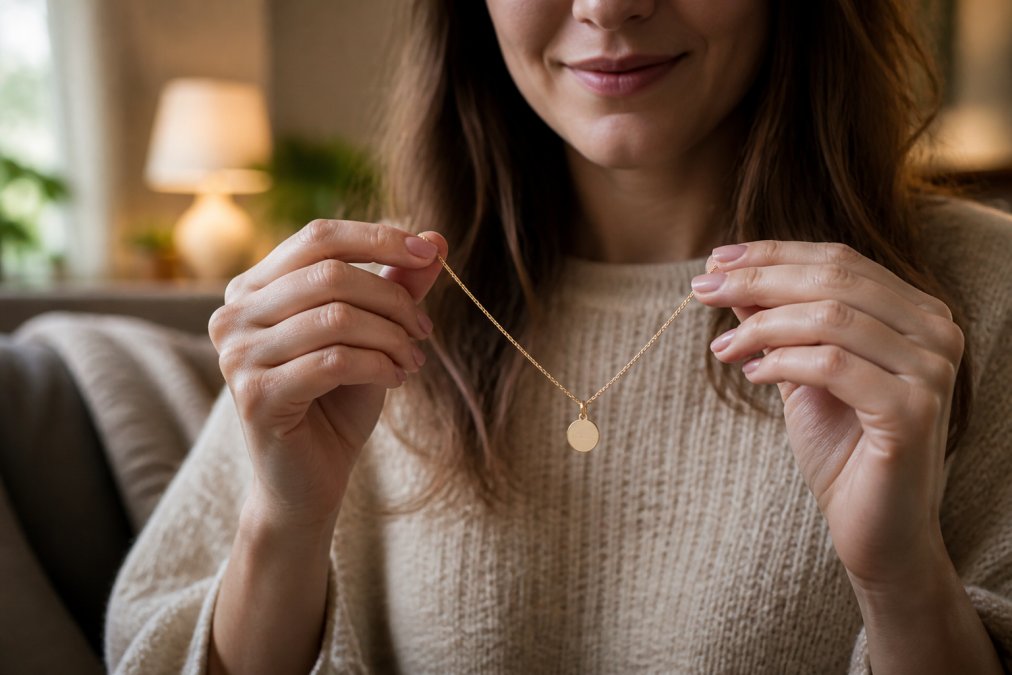
A personalized necklace gift for wife works because it is worn, not stored. Jewelry sits against the skin every day, which means the message attached to it gets repeated exposure. That is a different kind of reminder than a card that goes in a drawer.
Custom Message Card Jewelry: When Words and Metal Meet
Custom message card jewelry pairs a physical keepsake with written words, and that combination is what makes it stick. The necklace provides the object. The card provides the voice. Together they cover both the visual and the emotional side of a gift.
Budget-Friendly Personalization: Meaningful Gifts Without Overspending
Personalization does not require a large budget. The cost of a gift and its emotional impact are not the same number, and plenty of people overspend on gifts that land flat while a modest, specific one becomes a favorite. The practical question is where the money actually does work, and where it does not.
Where to focus your money:
- Spend on the detail, not the packaging. Engraving, a custom message, or a meaningful date adds more than a premium box. The box gets recycled; the inscription gets kept.
- Choose one strong element. A simple piece with a well-chosen inscription beats an elaborate piece with a generic one. One specific detail outperforms three vague ones.
- Skip the upsell. Extra add-ons rarely change how the gift feels. The core message does.
- Consider timing over extras. Ordering early so the gift arrives on the right day often matters more than any upgrade.
- Write the message yourself. A handwritten or personally worded card costs nothing and consistently outperforms a printed sentiment in how recipients describe the gift afterward.
The sustainability angle most gift guides ignore
There is a second reason budget-conscious personalization matters, and almost no gift guide addresses it: personalized gifts are less likely to be discarded. The same specificity that makes a gift emotionally sticky also makes it physically sticky. A generic scented candle, a novelty mug, or a mass-produced trinket has a short half-life, it gets regifted, donated, or thrown out within a year.
The Gift-Giver's Paradox: When Personalization Backfires
Personalization can miss, and it usually misses for one reason: the giver personalizes for themselves rather than the recipient. That is the gift-giver's paradox. The more effort you pour into a detail you love, the more it can feel like a mismatch to the person receiving it.
Three ways it goes wrong:
- Over-personalization. A gift covered in inside jokes or a nickname the recipient has outgrown can feel more like a reminder than a tribute.
- Wrong-format personalization. A custom item in a category the person never uses, such as jewelry for someone who does not wear it, sits unused no matter how thoughtful the message.
- Assumed taste. Choosing a style you find elegant without checking what the recipient actually wears.
Conclusion: Giving a Gift That Carries Your Voice
The hardest part of gifting is not finding something nice. It is finding something that sounds like you and lands with them. That gap is where most gifts fall short, and it is exactly what personalization closes.
Frequently Asked Questions
Why do personalized gifts create stronger emotional connections?
Personalized gifts show that you paid attention to the recipient's unique identity and preferences. This thoughtfulness triggers feelings of gratitude and self-esteem, making the gift feel like a meaningful gesture rather than a generic exchange. The emotional resonance comes from the effort and intention behind the customization, which strengthens the personal bond between giver and receiver.
What are the most popular personalized gifts for loved ones?
Popular options include custom message card jewelry and engraved necklaces. For a wife, a personalized necklace gift for wife with a heartfelt note is especially cherished. These gifts work because they combine a tangible object with a tailored experience that reflects the recipient's story and your relationship.
How do personalized gifts improve employee morale?
In corporate gifting, personalized items make employees feel seen and valued as individuals, not just staff. Recognizing milestones with a custom gift boosts employee engagement and reinforces a positive corporate culture. When the gift aligns with the person's interests, it increases perceived value and strengthens loyalty to the organization.
Are personalized gifts considered more thoughtful than generic items?
Yes, because they require time and attention to the recipient's unique identity. A generic gift can feel like an obligation, while a personalized gift communicates that you know the person well. This thoughtfulness creates a lasting impression and often leads to the item being kept and used, rather than discarded.